Posts tonen met het label Fermenteren. Alle posts tonen

dinsdag 2 april 2013

24 uurs yoghurt maken

Voor yoghurt maken heb je een goede kookthermometer nodig. Ik heb de mijne van de kookwinkel in de Passage in Den Haag, maar je kunt ze ook makkelijk online vinden. Ik wilde er één die ruim onder de 100 graden fahrenheit kon meten, de meeste zijn vanaf 100 graden, dat vond ik niet handig omdat dat juist ongeveer de temperatuur is die ik nodig heb voor yoghurt maken. Dus ik heb een iets duurdere (kostte iets van 25 euro).

Ik maak meestal 2 liter tegelijk, het blijft in de ijskast een paar weken goed, dus dat kan makkelijk.

Zo doe je het:
- koop rauwe melk (hebben ze o.a. bij 't Geertje) en een goede kwaliteit commerciële volle yoghurt
- per liter melk heb je 1/3-1/2 CUP commerciële yoghurt nodig
- verwarm de melk in een pan tot 110 graden FAHRENHEIT (=43 graden celsius)
- doe een beetje van de verwarmde melk in een apart bakje, doe daar de commerciële yoghurt bij en roer het goed door elkaar tot er geen brokjes meer in zitten. Dit doe je om ervoor te zorgen dat het mengsel van melk en yoghurt niet brokkig wordt.
- voeg dit mengsel toe aan de rest van de melk

Dan zijn er twee manieren die ik gebruik om yoghurt te maken. Meestal zet ik de yoghurt 24 uur lang in weckpotten in de droogoven op 110 graden fahrenheit. Als je geen droogoven hebt, kun je het ook op onderstaande manier doen met thermoskannen.

- doe de melk in thermoskannen (goed schoon! en geen kannen waar koffie in heeft gezeten of iets dergelijks, want dan krijg je yoghurt met koffiesmaak) 
- wikkel handdoeken om de thermoskannen, doe ze in een koeltas met een kruik met heet water
af en toe de kruik vervangen door een nieuwe met heet water
- na 24 uur schenk je de yoghurt in schone potten, deksel erop en bewaren in de ijskast.

De eerste keer heb ik af en toe de koeltas open gedaan om de temperatuur van de yoghurt in de thermoskannen te meten om te kijken of het warm genoeg bleef.

Over yoghurtmakers: die zijn dus niet noodzakelijk om yoghurt te kunnen maken, maar het kan natuurlijk wel. Ik heb al genoeg spullen in mijn keuken en heb toch al een droogoven, dus ik heb geen speciale yoghurtmakers gekocht. Let op de volgende zaken als je overweegt een yoghurtmaker te kopen: hoeveel kan er in en hoeveel yoghurt eet je per week en hoe vaak zou je dan dus yoghurt moeten maken? Is dat haalbaar?
Let er daarnaast op dat de meeste yoghurtmakers een timer hebben die je maximaal tot een uur of acht kan zetten. Dat is te kort, goede yoghurt moet minimaal 24 uur fermenteren. En zorg dat je de temperatuur tussen de 110-115 graden fahrenheit kan instellen.

donderdag 8 november 2012

Gefermenteerde vis

You can use homemade kefir or whey as a starter. For a one-litre jar you need
3-4 fresh herrings or mackerel. Skin the fish and remove the bones, cut into
mouth size pieces. Put the pieces of the fish into the jar mixing with slightly
crushed peppercorns, a few slices of white onion (optional), coriander seeds,
bay leaves and dill seeds or dill herb. In a separate jug in ½ litre of water
dissolve 1 tablespoon of sea salt and 3-4 tablespoons of your homemade whey.
Pour this brine into the jar with the fish until the fish is completely covered;
if the fish is not covered just add more water. Close the jar tightly and leave
to ferment for 3-5 days at a room temperature, then store in the fridge. This
fish does not keep long, so consume in the next few days. Serve with avocado and
onions.

Another way to ferment fish: buy some fresh sardines (also works for herring and
mackerel), de-scale the fish, cut the heads off and clean the belly out. Put
into a suitable size glass jar or a stainless steel pan. Add 1-2 cups of whey,
1-2 tablespoons of salt (per 1 litre), a teaspoon of black pepper corns (freshly
crushed), 10 bay leaves and ½ a teaspoon of coriander seeds (freshly crushed).
Top up with water so the fish is completely covered with water, you may want to
float a small plate on top of the fish to keep it submerged in the brine. Cover
the pan or put the lead on the jar and let it ferment for 3-5 days at a room
temperature. When the fish is ready take the meat off the bones, cut into
bite-size pieces and serve with avocado, fresh dill and some chopped red onion.

Taken from www.gaps.me

Beet kvass

Durga’s Beet Kvass Recipe:

Beet Kvass is a effervescent lactic acid fermented beverage which you can easily make at home from beets, water and sea salt. It can be consumed as a tonic drink, or used to make a vinaigrette dressing. Beet kvass, like other lactic acid fermented drinks, is best consumed in relatively small amounts. It is considered a tonic drink, due to the many health benefits from nutrients, enzymes and beneficial organisms in it. Kvass is also made from stale rye bread. No traditional Ukranian home was without its bottle of beet kvass, according to Lubow A. Kylvska, author of Ukranian Dishes.

Folk medicine values beets and beet kvass for their liver cleansing properties and beet kvass is widely used in cancer therapy in Europe. Anecdotal reports indicate that beet kvass is an excellent therapy for chronic fatigue, chemical sensitivities, allergies and digestive problems. (from Weston A Price Foundation website.)

Note to Sally Fallon fans: the following recipe is adapted from Fallon. Many people start out all excited to make beet kvass and find the results unpalatable and give up. The secret is to use just a pinch of salt (prefer Celtic coarse) and ½ a cup of whey (or more, if you have lots to use up!)
Basic Beet Kvass

Batch 1:
2-4 medium to large beets, scrubbed, unpeeled, coarsely chopped
½ cup whey leftover from making homemade cheese from raw milk (powdered will *not* do)
pinch sea salt (Celtic salt is preferred as it adds minerals)
about 1-1/2 qts filtered water (not fizzy mineral water)

Combine all ingredients in 2 qt. glass jar. Fill rest of jar w/ water, leaving about 1-1/2 inches headroom.

Invert jar to gently mix ingredients. Place on a counter. Kvass will be ready in 2-4 days, depending on outside temp. Try to mix by turning jar a couple times/day. You can tell it’s ready by the rich red color, by floating beet pieces (means good amount of lactic acid has developed), and by the presence of “bloom” (mold) on top.

Subsequent Batches:
When kvass is finished, gently scoop off as much bloom as you can. Strain liquid into bowl, and transfer to another 2 qt. glass jar. Refrigerate. You may drink at full strength, but as it is concentrated, you may wish to dilute half with mineral water, and add 1-2 tsp honey. It is delightful taken this way, a very pleasant “beet soda.” Children like it, and it looks beautiful.

Then, wash the quartered beets well. They will be slimy. Also wash out the jar they fermented in well with hot water. Chop the beets one size smaller, and place back in fermenting jar, again with half cup way and pinch salt. Repeat whole process. I have gotten up to 4 lovely batches of kvass this way-so three beets last about 2 weeks!

Variations:
Are endless. Kvass is very nice with a teaspoon of cinnamon (a good blood toning combo); also ginger root and lemon (careful! The ginger gets very heady—open slowly or you may have a bubbling mess!); also my favorite is cranberry concentrate—making a great female tonic. For a real treat you may also make it with half water and half freshly juiced apples or pears. It is also nice with dried mint (just crush mint leaves and add to the jar with the beets.)

I would advise against adding honey to the fermenting batch, or using fizzy mineral water, as both slow fermentation; but added after, both (especially the honey) bring health benefits.

Bron: https://sites.google.com/site/spiritualfoodcsa/food-a-pedia/beets

woensdag 12 september 2012

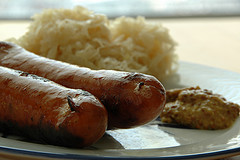
Zelfgemaakte zuurkool

Ingredients:
4 or 5 heads of read or green cabbage, shredded;
1/4 cup sea salt;

Preparation:
Place the shredded cabbage little by little in your fermentation jar, pounding them vigorously and sprinkling some of the sea salt as you go.
Make sure the mixture fills the jar up to 1 inch bellow the top (because of the expansion), adding more if needed, and that the extracted water covers the vegetables entirely. If not, create a brine of 2 tablespoons sea salt to 4 cups water and add it to the cabbage.
Press the vegetables and keep them under the brine by placing a plate or a lid on top weighted down by a rock or a jug of water. Cover with a clean towel if needed to keep out fruit flies.
Place the fermentation jar in a warm spot in your kitchen and allow the Sauerkraut to ferment for 7 to 10 days.
Check on it from time to time to be sure that the brine covers the vegetables and to remove any mold that may form on the surface.
A good way to know when it’s ready is to taste it during the fermentation process and move it to the refrigerator when you’re satisfied with the taste.